
Year 9 · Science · KS3 · free one-page sheet
Science investigation skills
A free one-page printable on science investigation skills for Year 9 (KS3): independent, dependent and control variables, hypotheses, repeats and anomalies in one table, with a worked example, the common mistake and three recall questions. It belongs to our Year 9 Science page on this topic, where every linked resource has been checked.
Download
A short learning loop
Understand it, try it, remember it
Work through these five steps in order. Nothing is saved, and the tick boxes stay on this page only.
- 1
Understand
In a fair-test experiment you change one thing, measure one thing and keep the other relevant variables the same. Name the variables first; then plan the range, the equipment, the repeats and how you will record the results.
- 2
Try
A student wants to find out whether the length of a pendulum string changes how long one swing takes. Identify the variables.
Independent variable: the length of the string, because that is what the student changes on purpose.
Dependent variable: the period of the pendulum. Time 10 complete oscillations and divide the total time by 10, so reaction time matters less. Control variables: the mass on the end, the release angle and the type of string, kept the same so only the length can cause a difference.
- 3
Remember
- 4
Apply
Use one checked resource to practise the same idea in a different way.
- 5
The sheet, written out
Key idea
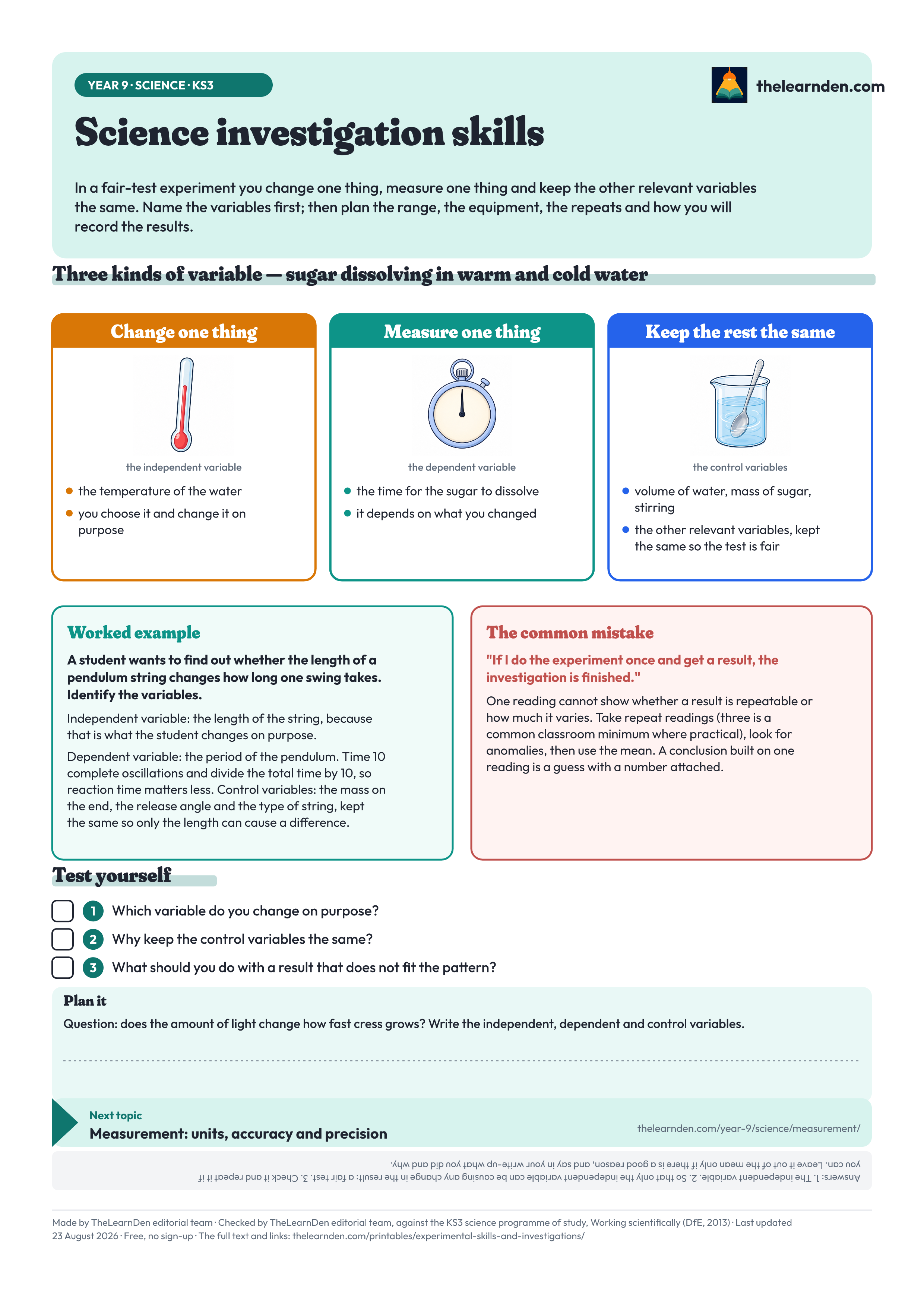
In a fair-test experiment you change one thing, measure one thing and keep the other relevant variables the same. Name the variables first; then plan the range, the equipment, the repeats and how you will record the results.
Three kinds of variable — sugar dissolving in warm and cold water
Change one thing
- the temperature of the water
- you choose it and change it on purpose
Measure one thing
- the time for the sugar to dissolve
- it depends on what you changed
Keep the rest the same
- volume of water, mass of sugar, stirring
- the other relevant variables, kept the same so the test is fair
Worked example
A student wants to find out whether the length of a pendulum string changes how long one swing takes. Identify the variables.
Independent variable: the length of the string, because that is what the student changes on purpose.
Dependent variable: the period of the pendulum. Time 10 complete oscillations and divide the total time by 10, so reaction time matters less. Control variables: the mass on the end, the release angle and the type of string, kept the same so only the length can cause a difference.
The common mistake
"If I do the experiment once and get a result, the investigation is finished."
One reading cannot show whether a result is repeatable or how much it varies. Take repeat readings (three is a common classroom minimum where practical), look for anomalies, then use the mean. A conclusion built on one reading is a guess with a number attached.
Test yourself
- Which variable do you change on purpose?
- Why keep the control variables the same?
- What should you do with a result that does not fit the pattern?
Plan it
- Question: does the amount of light change how fast cress grows? Write the independent, dependent and control variables.
- How many readings will you take, and why?
Next topic
Questions parents ask
What are the independent, dependent and control variables?
The independent variable is the one thing you change on purpose. The dependent variable is the thing you measure to see the effect. Control variables are everything else, kept the same so the test is fair.
Why do scientists repeat readings?
One reading cannot show whether a result is repeatable. Repeating each test and taking a mean evens out small errors and makes anomalies, results that do not fit the pattern, easy to spot. An anomaly should be checked and repeated before it is left out.
When is this taught?
Working scientifically runs through the whole of Key Stage 3 science (Years 7 to 9) and continues into GCSE. This sheet sits under Year 9 on TheLearnDen, with a parent guide to the same skills.
Is the sheet free?
Yes. One A4 page, PDF or PNG, no sign-up. Print at 100% (actual size).
More like this
- Science investigation skills — Year 9
The topic page, with checked videos, lessons and practice.
- Parent guide: science investigation skills
The same topic at a different level.
- All free printables
One-page topic sheets, roadmaps, bookmarks and stickers.