
Year 4 · Maths · KS2 · free one-page sheet
Lines of symmetry in 2D shapes
A free one-page printable on lines of symmetry in 2D shapes for Year 4 (KS2) maths: a table of common shapes and their lines of symmetry, a worked example on the rectangle's diagonal, the common mistake, and three recall questions. It belongs to our Year 4 Maths page on this topic, where every linked resource has been checked.
Download
The sheet, written out
Key idea
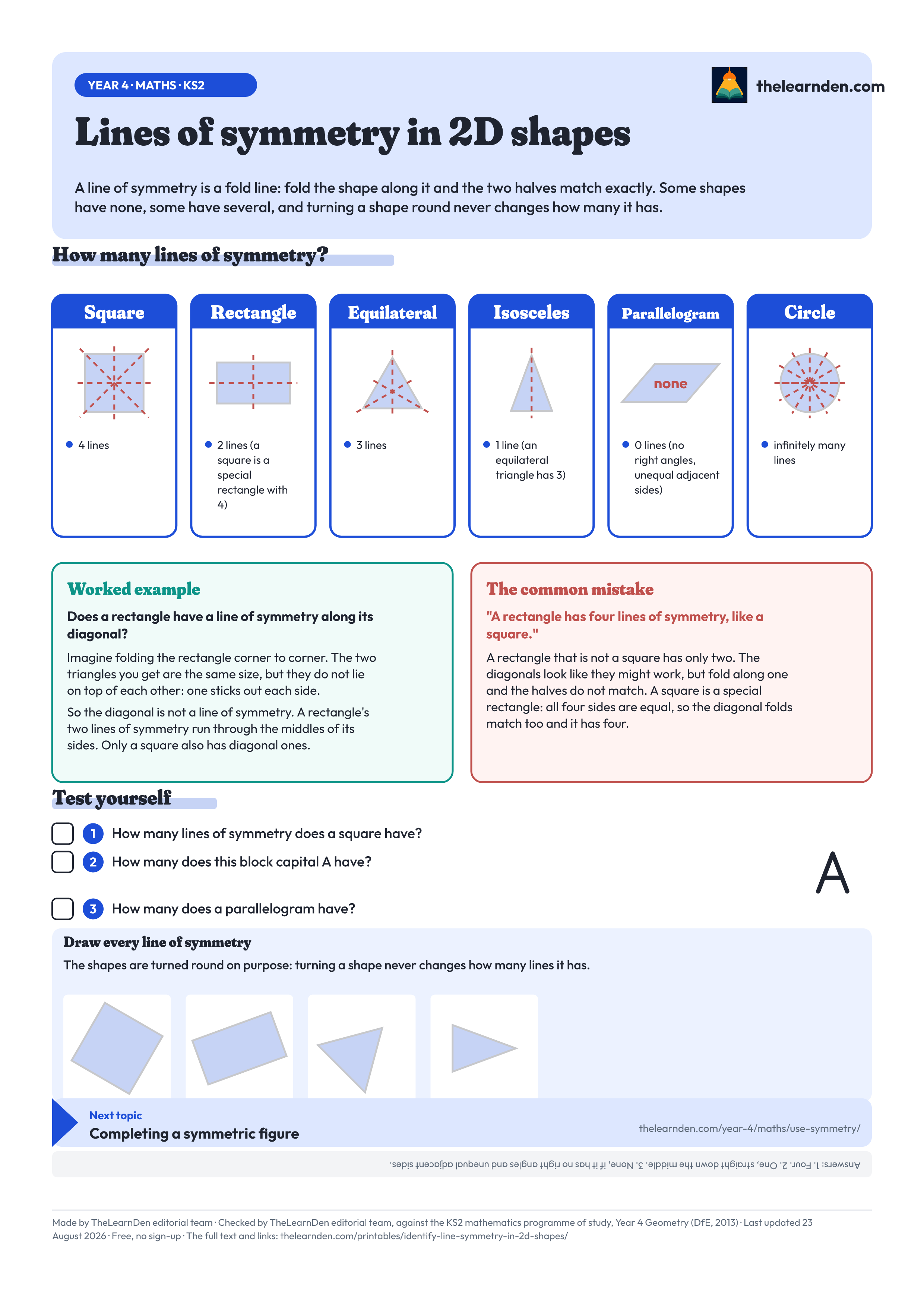
A line of symmetry is a fold line: fold the shape along it and the two halves match exactly. Some shapes have none, some have several, and turning a shape round never changes how many it has.
How many lines of symmetry?
Square
- 4 lines
Rectangle
- 2 lines (a square is a special rectangle with 4)
Equilateral
- 3 lines
Isosceles
- 1 line (an equilateral triangle has 3)
Parallelogram
- 0 lines (no right angles, unequal adjacent sides)
Circle
- infinitely many lines
Worked example
Does a rectangle have a line of symmetry along its diagonal?
Imagine folding the rectangle corner to corner. The two triangles you get are the same size, but they do not lie on top of each other: one sticks out each side.
So the diagonal is not a line of symmetry. A rectangle's two lines of symmetry run through the middles of its sides. Only a square also has diagonal ones.
The common mistake
"A rectangle has four lines of symmetry, like a square."
A rectangle that is not a square has only two. The diagonals look like they might work, but fold along one and the halves do not match. A square is a special rectangle: all four sides are equal, so the diagonal folds match too and it has four.
Test yourself
- How many lines of symmetry does a square have?
- How many does this block capital A have?
- How many does a parallelogram have?
Draw every line of symmetry
- The shapes are turned round on purpose: turning a shape never changes how many lines it has.
Next topic
Questions parents ask
What is a line of symmetry?
A line that divides a shape into two halves that are mirror images of each other. Fold the shape along the line and the two halves match exactly.
How many lines of symmetry does a rectangle have?
Two, through the middles of opposite sides. The diagonals are not lines of symmetry unless the rectangle is a square, which is a special rectangle with four.
When is this taught?
Identifying lines of symmetry in 2D shapes presented in different orientations is in the Year 4 mathematics programme of study in England. Year 4 also completes simple symmetric figures.
Is the sheet free?
Yes. One A4 page, PDF or PNG, no sign-up. Print at 100% (actual size).
More like this
- Lines of symmetry in 2D shapes — Year 4
The topic page, with checked videos, lessons and practice.
- All free printables
One-page topic sheets, roadmaps, bookmarks and stickers.