
Year 9 · Science · KS3 · free one-page sheet
The reactivity series, including carbon
A free one-page printable on the reactivity series, including carbon and hydrogen, for Year 9 (KS3) science: the full series as a ladder, a worked example on reducing iron oxide with carbon, the "carbon is a metal" mistake, a GCSE extension box and three recall questions. It belongs to our Year 9 Science page on this topic, where every linked resource has been checked.
Download
The sheet, written out
Key idea
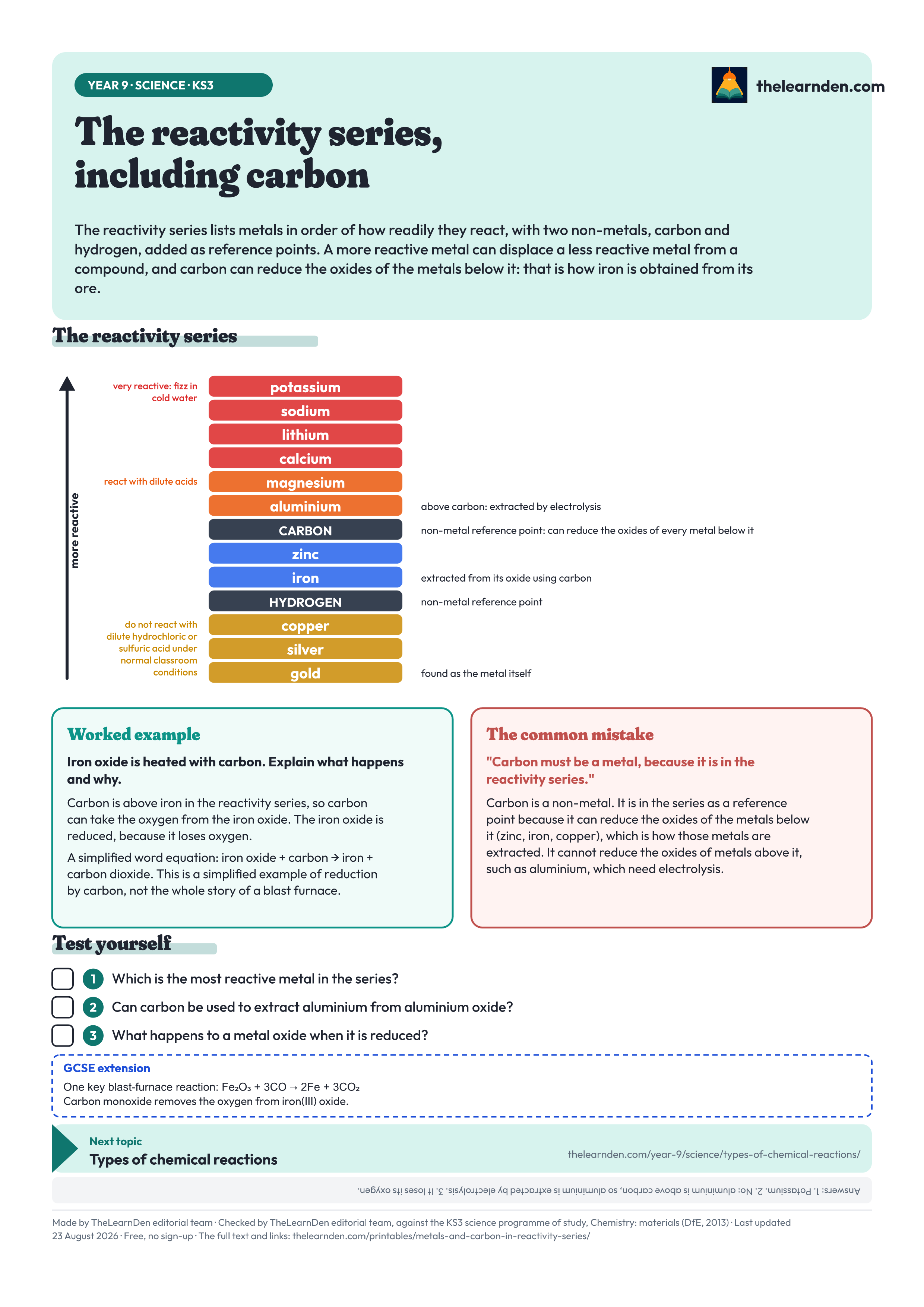
The reactivity series lists metals in order of how readily they react, with two non-metals, carbon and hydrogen, added as reference points. A more reactive metal can displace a less reactive metal from a compound, and carbon can reduce the oxides of the metals below it: that is how iron is obtained from its ore.
The reactivity series (most reactive first)
- potassium — very reactive: fizz in cold water
- sodium
- lithium
- calcium
- magnesium — react with dilute acids
- aluminium — above carbon: extracted by electrolysis
- CARBON — non-metal reference point: can reduce the oxides of every metal below it
- zinc
- iron — extracted from its oxide using carbon
- HYDROGEN — non-metal reference point
- copper — do not react with dilute hydrochloric or sulfuric acid under normal classroom conditions
- silver
- gold — found as the metal itself
Worked example
Iron oxide is heated with carbon. Explain what happens and why.
Carbon is above iron in the reactivity series, so carbon can take the oxygen from the iron oxide. The iron oxide is reduced, because it loses oxygen.
A simplified word equation: iron oxide + carbon → iron + carbon dioxide. This is a simplified example of reduction by carbon, not the whole story of a blast furnace.
The common mistake
"Carbon must be a metal, because it is in the reactivity series."
Carbon is a non-metal. It is in the series as a reference point because it can reduce the oxides of the metals below it (zinc, iron, copper), which is how those metals are extracted. It cannot reduce the oxides of metals above it, such as aluminium, which need electrolysis.
Test yourself
- Which is the most reactive metal in the series?
- Can carbon be used to extract aluminium from aluminium oxide?
- What happens to a metal oxide when it is reduced?
GCSE extension
- One key blast-furnace reaction: Fe₂O₃ + 3CO → 2Fe + 3CO₂
- Carbon monoxide removes the oxygen from iron(III) oxide.
Next topic
Questions parents ask
What is the reactivity series?
A list of metals in order of how readily they react, from potassium at the top down to gold at the bottom, with the non-metals carbon and hydrogen added as reference points. A more reactive metal can displace a less reactive metal from a compound.
Why is carbon in the reactivity series when it is not a metal?
Because carbon can reduce the oxides of the metals below it, such as zinc, iron and copper, taking away their oxygen. That is how iron is obtained from iron ore. Metals above carbon, such as aluminium, have to be extracted by electrolysis.
When is this taught?
The order of metals and carbon in the reactivity series, and using carbon to obtain metals from metal oxides, are in the Key Stage 3 science programme of study in England. GCSE chemistry adds hydrogen as a reference point and the blast-furnace reactions.
Is the sheet free?
Yes. One A4 page, PDF or PNG, no sign-up. Print at 100% (actual size).
More like this
- The reactivity series, including carbon — Year 9
The topic page, with checked videos, lessons and practice.
- All free printables
One-page topic sheets, roadmaps, bookmarks and stickers.