
Year 8 · Science · KS3 · free one-page sheet
Separating mixtures
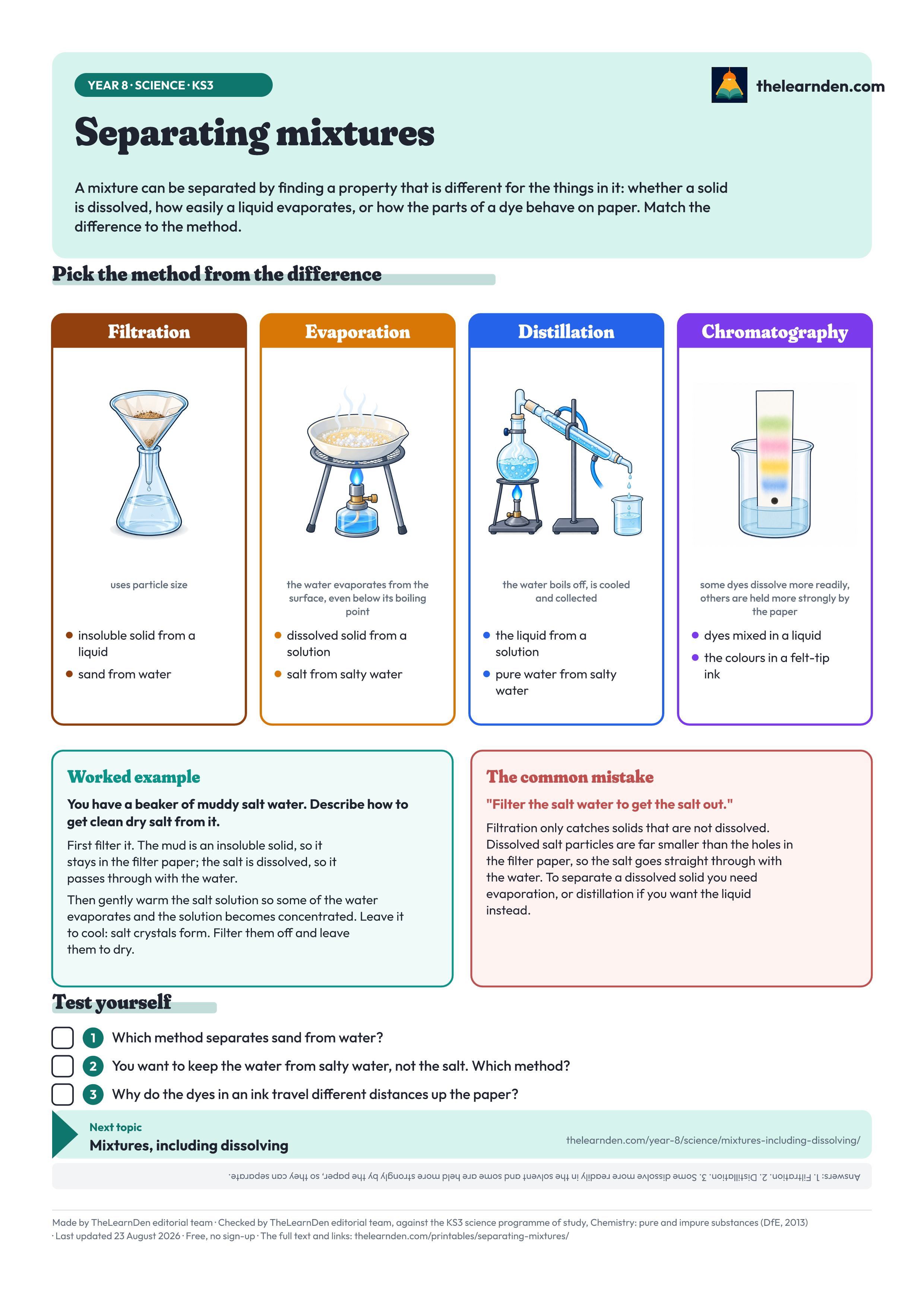
A free one-page printable on separating mixtures for Year 8 (KS3) science: filtration, evaporation, distillation and chromatography in one table, a worked example, the "filter the salt out" mistake, and three recall questions. It belongs to our Year 8 Science page on this topic, where every linked resource has been checked.
Download
The sheet, written out
Key idea
A mixture can be separated by finding a property that is different for the things in it: whether a solid is dissolved, how easily a liquid evaporates, or how the parts of a dye behave on paper. Match the difference to the method.
Pick the method from the difference
Filtration
- insoluble solid from a liquid
- sand from water
Evaporation
- dissolved solid from a solution
- salt from salty water
Distillation
- the liquid from a solution
- pure water from salty water
Chromatography
- dyes mixed in a liquid
- the colours in a felt-tip ink
Worked example
You have a beaker of muddy salt water. Describe how to get clean dry salt from it.
First filter it. The mud is an insoluble solid, so it stays in the filter paper; the salt is dissolved, so it passes through with the water.
Then gently warm the salt solution so some of the water evaporates and the solution becomes concentrated. Leave it to cool: salt crystals form. Filter them off and leave them to dry.
The common mistake
"Filter the salt water to get the salt out."
Filtration only catches solids that are not dissolved. Dissolved salt particles are far smaller than the holes in the filter paper, so the salt goes straight through with the water. To separate a dissolved solid you need evaporation, or distillation if you want the liquid instead.
Test yourself
- Which method separates sand from water?
- You want to keep the water from salty water, not the salt. Which method?
- Why do the dyes in an ink travel different distances up the paper?
Next topic
Questions parents ask
What are the four ways of separating mixtures at KS3?
Filtration (an insoluble solid from a liquid), evaporation (a dissolved solid from a solution), distillation (the liquid from a solution) and chromatography (dyes mixed in a liquid). Each uses a difference: whether something is dissolved, how easily a liquid evaporates, or how the dyes dissolve and how strongly the paper holds them.
Why can't you filter salt out of salt water?
Dissolved salt particles are far smaller than the holes in filter paper, so they pass straight through. Evaporation leaves the salt behind; distillation collects the water.
When is this taught?
Simple techniques for separating mixtures, filtration, evaporation, distillation and chromatography, are in the Key Stage 3 science programme of study in England, usually taught in Year 7 or 8.
Is the sheet free?
Yes. One A4 page, PDF or PNG, no sign-up. Print at 100% (actual size).
More like this
- Separating mixtures — Year 8
The topic page, with checked videos, lessons and practice.
- All free printables
One-page topic sheets, roadmaps, bookmarks and stickers.