TheLearnDen

Year 6 · Maths

Year 6 BODMAS questions, examples and worksheet

BODMAS tells you which operation to calculate first: brackets, powers, multiplication and division, then addition and subtraction. Work from left to right within each equal-priority pair. Practise Year 6 questions with Noah’s worked examples, a video, our game and a worksheet you can complete online or print.

Allow about 30–45 minutes for the lesson and one practice choice. Take a break or finish another day if you need to.

Progress controls need JavaScript. Saving has not been checked.

Find more resources

Teach: find the groups

BODMAS is a memory aid for the order of operations: which part of an expression to calculate first.

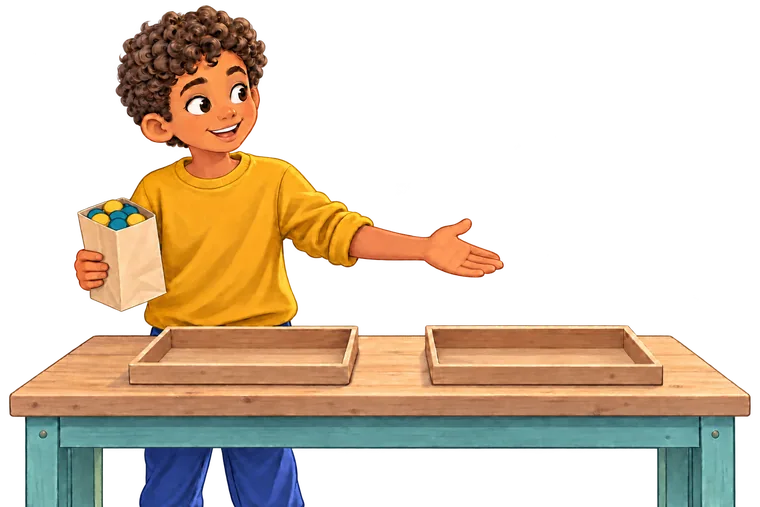
Noah holds a paper bag containing blue and gold tokens, ready to prepare two separate school-fair orders.
Meet Noah. What does each bag need to contain?

Noah is preparing two different token orders for a school fair.

One order has loose tokens and bags. The other has three mixed bags. The arrangements are different, so their expressions need different brackets.

What you’ll learn
  • Choose which calculation comes first.
  • Use brackets, powers and equal priorities correctly.
  • Explain and correct a mistake.

1 · READ THE TOKEN ORDERS

Turn each picture into an expression

This is the worked model. In Order A, keep the six loose tokens separate, then show the two bags of three as 2 × 3: 6 + 2 × 3. In Order B, group the six blue and two gold tokens inside each bag: (6 + 2) × 3.

Order A

A · loose tokens + two bags6 + 2 × 3

6 + 2 × 3

Order B

B · three mixed bags(6 + 2) × 3

(6 + 2) × 3

Group and ungroup the tokens. The six loose tokens in A stay separate from the bags.

2 · SEE HOW THE ORDER WORKS

Follow each calculation one step at a time

  1. Brackets: calculate inside them first.
  2. Orders: powers such as squares; a square means multiply a number by itself. For example, 3² = 3 × 3, not 3 × 2.
  3. Multiplication and division: they have equal priority, so work from left to right.
  4. Addition and subtraction: they have equal priority, so work from left to right.

Multiplication and division

20 ÷ 5 × 2

20 ÷ 5 = 4, then 4 × 2 = 8.

Do not multiply 5 × 2 first. Division and multiplication share the same priority.

Addition and subtraction

16 − 7 + 3

16 − 7 = 9, then 9 + 3 = 12.

Do not add 7 + 3 first. Addition and subtraction share the same priority.

Brackets, then a power

(2 + 1)² + 4

2 + 1 = 3, so 3² + 4. Then 3² = 9, so 9 + 4 = 13.

3² means 3 × 3, not doubling 3.

Some resources use BIDMAS. Its “I” means indices, another name for powers. The order is the same.

3 · TRY IT YOURSELF

Choose the first step and finish each calculation

You have seen how the rules work. Now choose the first operation and enter the final answer. If something is wrong, use the hint and try again.

Check 1 of 5
In Order A, which part do you calculate first?

6 + 2 × 3

Need a hint?

Start with brackets, then powers. Multiplication and division share a priority, as do addition and subtraction. In either pair, work from the left.

4 · CHECK YOUR THINKING

Spot and fix the mistake

Sam works out 5 + 3 × 2 like this: (5 + 3) × 2 = 16. What did Sam change, and what is the correct answer? Try it on paper before opening the answer.

See one possible correction

The expression has no brackets, so the 3 × 2 multiplication comes first. Then add the 5: 5 + 6 = 11. Sam added 5 + 3 first, which changed the order by adding brackets that were not there.

Take the idea into your worksheet

All 14 questions continue Noah’s token orders and the rules you have just used. Their main focus is:

  • Token groups and brackets: questions 1, 4, 5, 12 and 13.
  • Choosing the next operation: questions 2, 3, 6, 7 and 8.
  • Powers: questions 9 and 10.
  • Explain, correct or create: questions 11 and 14.

Show the first step in your working. Then finish the question and check whether your answer fits the token story.

Watch an explanation

Open the explanation on Oak National Academy, then come back here to try the question below.

Combine multiplication with addition and subtraction

Watch on Oak National Academy

Oak National Academy · Video lesson

Watch how multiplication, addition, subtraction and brackets work together. Use our examples for powers and division too.

Video details

A maths lesson by Oak National Academy, licensed under the Open Government Licence.

Back here? Try this

Noah has four loose tokens and three bags of five. Which expression matches: 4 + 3 × 5 or (4 + 3) × 5? What do you calculate first?

See the answer

4 + 3 × 5 = 19. Find the 15 bagged tokens first, then add the four loose tokens.

Practice what you’ve learned

Choose a game or a worksheet. You can try both.

Write

Year 6 BODMAS worksheet

Work through the same 14 questions online, type your answers and optional working, then print your work.

Do the worksheet online Download the blank worksheet

Free lesson and game · Year 6 · Worksheet online or on A4 · Blank PDF: three pages · Separate adult answers

Before you finish

Say or write an expression of your own. Which calculation comes first, and why?

My activity record 1 skill to practise

Skills for this topic

Open a matched resource below, then mark the skill after you have practised it. These are skills within this Year 6 topic.

One resource can help with several skills. Our game and worksheets are in Practice above.

If this browser can save your activity marks, they stay on this device. Use Undo Done to undo a mark. Tickets already earned stay unchanged.

  • Understand and Apply BODMAS Skills
    Watch video

    Watch: Oak National Academy · Check access

    Other resources for this skill (2)
    • Practice: Corbettmaths PrimaryOrder of Operations - Primary Practice Questions (BODMAS)Check access
    • Teach: TwinklPlanit Maths Y6 Addition Subtraction Multiplication And Division Lesson Pack Order Of Operations 5Check access

Find more resources

We match these resources to the topic. Check each provider’s access and review labels before you open a resource. How we choose resources.

More ways to learn

Explore the resources matched to this topic. Choose the types you want to see.

Access

All free includes resources that ask for a free account.

Resource type
5 of 5 extra resources
What the icons and labels mean

Formats

Watch. a video explanation

Teach. a lesson or teaching page to read and work through

Practice. questions, activities or worksheets to try

Cost and account

Free no payment or account needed for this resource

no payment needed, but the provider asks you to create an account

part of a paid plan on that site

Check access access has not yet been confirmed, so it appears only under Any access

Review status

Verified match checked against this topic, with a visible check date

Reviewed, not fully verified reviewed, with some checks still outstanding

Awaiting review still waiting for review

Tell us how it went

This helped · Link or access problem · Not the right match

We show a free label only after checking the resource's own page. Access can vary by resource. Unconfirmed access appears only under Any access.

TeachCorbettmaths Primary

Order of Operations Questions

Best for: Work through another set of order-of-operations questions.

Check access

Current access not verified. Opens on Corbettmaths Primary’s site.

Open at Corbettmaths Primary

TeachTwinkl

Year 6 Order of Operations Lesson Pack

Best for: Explore a structured Year 6 lesson pack.

Check access

Current access not verified. Opens on Twinkl’s site.

Open at Twinkl

WatchOak National Academy

Combine multiplication with addition and subtraction

Best for: Want to focus on grouping? This explanation combines multiplication with addition and subtraction.

Check access

Current access not verified. Opens on Oak National Academy’s site.

Open at Oak National Academy

PracticeOak National Academy

Order of operations worksheet options

Best for: Open the worksheet options from Oak National Academy.

Check access

Current access not verified. Opens on Oak National Academy’s site.

Open at Oak National Academy

PracticeCorbettmaths Primary

Order of operations questions

Best for: Practise with printable mixed-operation questions.

Check access

Current access not verified. Opens on Corbettmaths Primary’s site.

Open at Corbettmaths Primary

Resource feedback needs JavaScript and the native feedback controls. No feedback has been submitted.

Where next?

Browse all Year 6 Maths lessons

Share this lesson WhatsApp