
Year 6 · Maths · KS2 · free one-page sheet
BODMAS: the order of operations
A free one-page printable on BODMAS, the order of operations, for Year 6 (KS2) maths: the four steps with examples, a worked exam-style question, the common left-to-right mistake, and three quick recall questions. It belongs to our Year 6 Maths page on this topic, where every linked resource has been checked.
Download
A short learning loop
Understand it, try it, remember it
Work through these five steps in order. Nothing is saved, and the tick boxes stay on this page only.
- 1
Understand
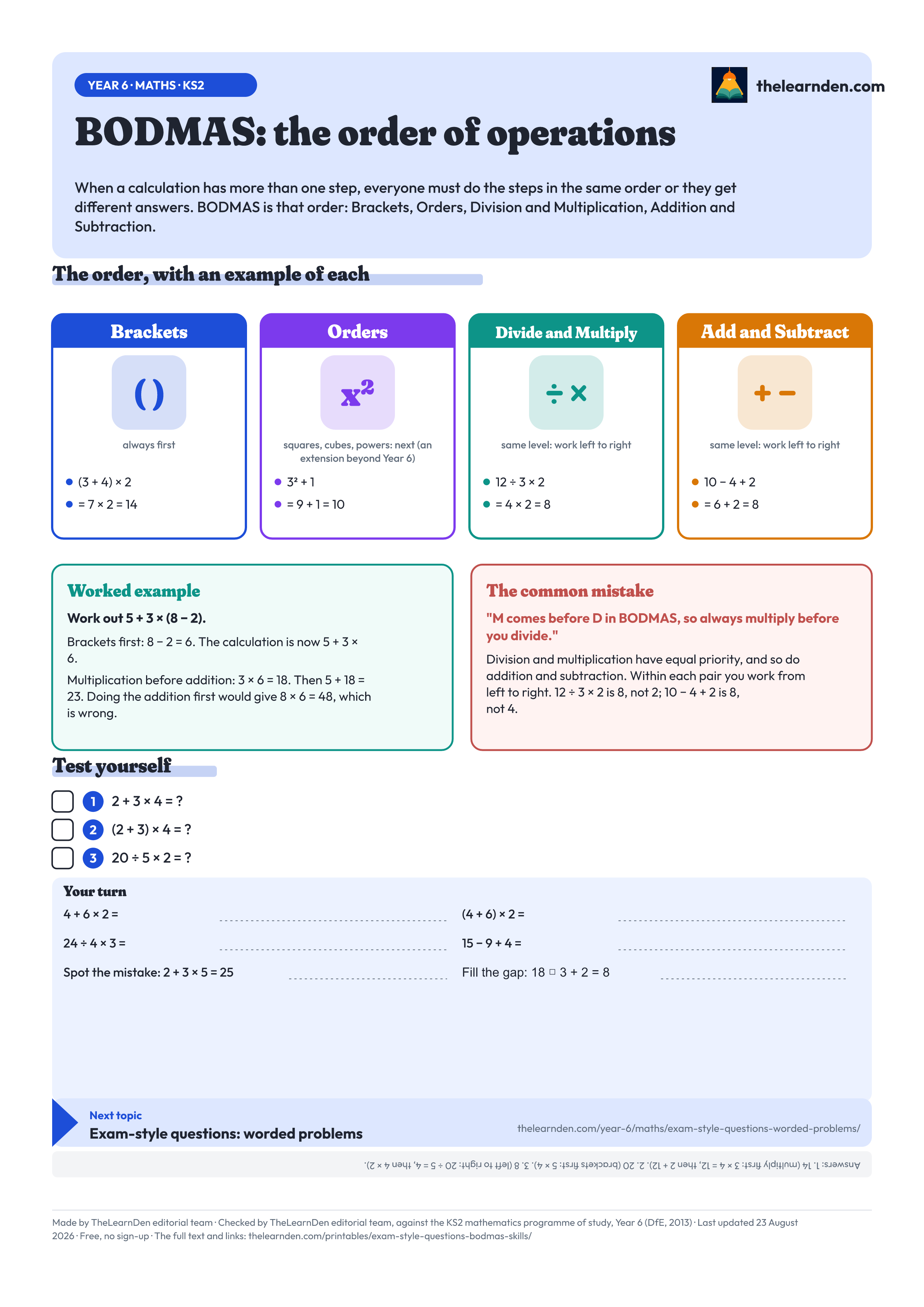
When a calculation has more than one step, everyone must do the steps in the same order or they get different answers. BODMAS is that order: Brackets, Orders, Division and Multiplication, Addition and Subtraction.
- 2
Try
Work out 5 + 3 × (8 − 2).
Brackets first: 8 − 2 = 6. The calculation is now 5 + 3 × 6.
Multiplication before addition: 3 × 6 = 18. Then 5 + 18 = 23. Doing the addition first would give 8 × 6 = 48, which is wrong.
- 3
Remember
- 4
Apply
Use one checked resource to practise the same idea in a different way.
- 5
The sheet, written out
Key idea
When a calculation has more than one step, everyone must do the steps in the same order or they get different answers. BODMAS is that order: Brackets, Orders, Division and Multiplication, Addition and Subtraction.
The order, with an example of each
Brackets
- (3 + 4) × 2
- = 7 × 2 = 14
Orders
- 3² + 1
- = 9 + 1 = 10
Divide and Multiply
- 12 ÷ 3 × 2
- = 4 × 2 = 8
Add and Subtract
- 10 − 4 + 2
- = 6 + 2 = 8
Worked example
Work out 5 + 3 × (8 − 2).
Brackets first: 8 − 2 = 6. The calculation is now 5 + 3 × 6.
Multiplication before addition: 3 × 6 = 18. Then 5 + 18 = 23. Doing the addition first would give 8 × 6 = 48, which is wrong.
The common mistake
"M comes before D in BODMAS, so always multiply before you divide."
Division and multiplication have equal priority, and so do addition and subtraction. Within each pair you work from left to right. 12 ÷ 3 × 2 is 8, not 2; 10 − 4 + 2 is 8, not 4.
Test yourself
- 2 + 3 × 4 = ?
- (2 + 3) × 4 = ?
- 20 ÷ 5 × 2 = ?
Your turn
- 4 + 6 × 2 =
- (4 + 6) × 2 =
- 24 ÷ 4 × 3 =
- 15 − 9 + 4 =
- Spot the mistake: 2 + 3 × 5 = 25
- Fill the gap: 18 □ 3 + 2 = 8
Next topic
Questions parents ask
What does BODMAS stand for?
Brackets, Orders (squares, cubes and other powers), Division and Multiplication, Addition and Subtraction. It is the order in which the steps of a calculation are done. Some schools say BIDMAS, with I for Indices; it is the same rule.
Does multiplication always come before division?
No. Division and multiplication are at the same level, and so are addition and subtraction. Within each pair you work from left to right, so 12 ÷ 3 × 2 is 8, not 2.
When is this taught?
The order of operations is in the Year 6 mathematics programme of study in England and appears in the Key Stage 2 SATs arithmetic and reasoning papers. It is used throughout secondary maths.
Is the sheet free?
Yes. One A4 page, PDF or PNG, no sign-up. Print at 100% (actual size).
More like this
- BODMAS: the order of operations — Year 6
The topic page, with checked videos, lessons and practice.
- All free printables
One-page topic sheets, roadmaps, bookmarks and stickers.