
Year 3 · Science · KS2 · free one-page sheet
Parts of a flowering plant and their jobs
A free one-page printable on the parts of a flowering plant for Year 3 (KS2) science: roots, stem, leaves and flowers with their jobs in one table, a worked example, the "food from soil" mistake, and three recall questions. It belongs to our Year 3 Science page on this topic, where every linked resource has been checked.
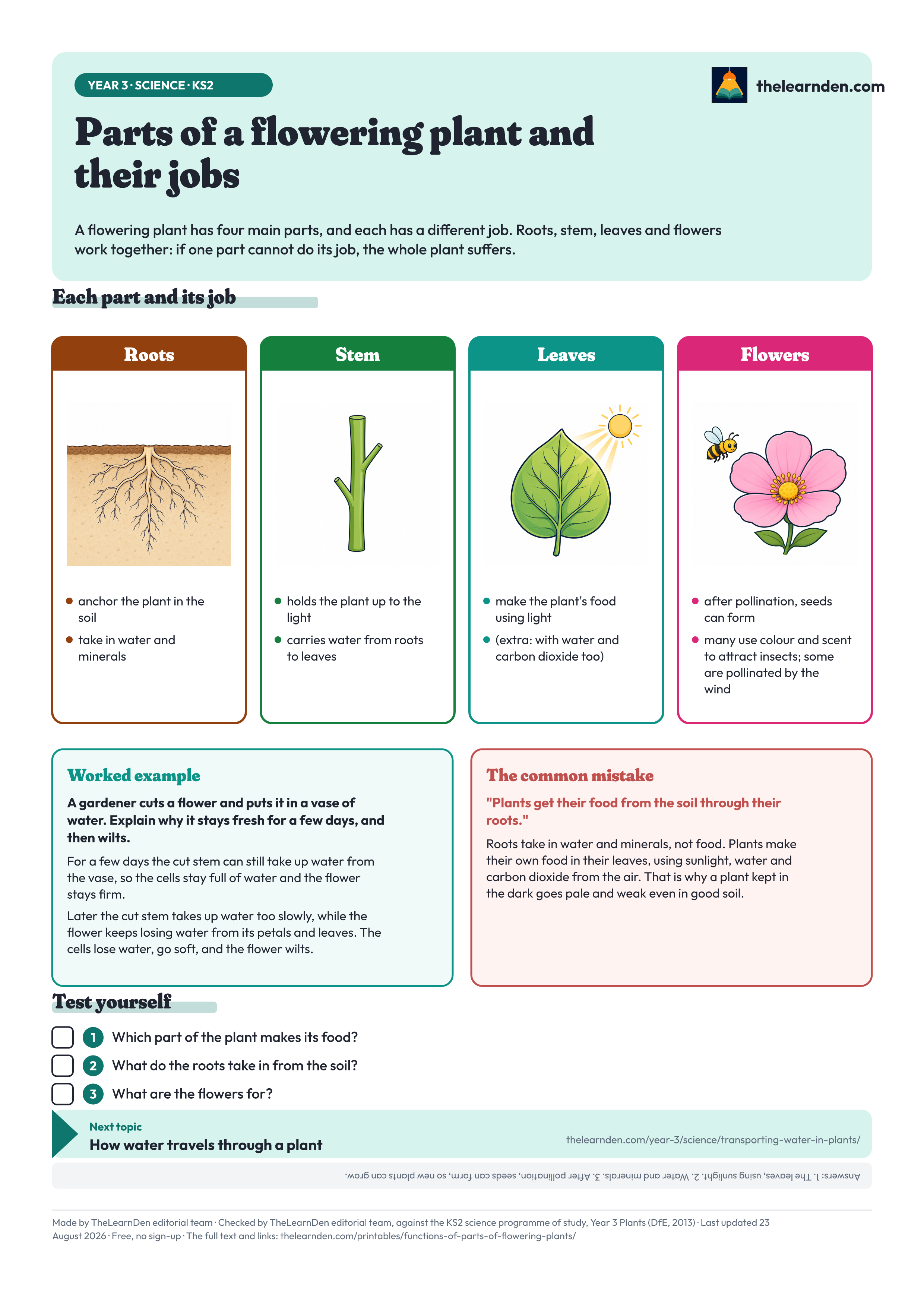
Download
The sheet, written out
Key idea
A flowering plant has four main parts, and each has a different job. Roots, stem, leaves and flowers work together: if one part cannot do its job, the whole plant suffers.
Each part and its job
Roots
- anchor the plant in the soil
- take in water and minerals
Stem
- holds the plant up to the light
- carries water from roots to leaves
Leaves
- make the plant's food using light
- (extra: with water and carbon dioxide too)
Flowers
- after pollination, seeds can form
- many use colour and scent to attract insects; some are pollinated by the wind
Worked example
A gardener cuts a flower and puts it in a vase of water. Explain why it stays fresh for a few days, and then wilts.
For a few days the cut stem can still take up water from the vase, so the cells stay full of water and the flower stays firm.
Later the cut stem takes up water too slowly, while the flower keeps losing water from its petals and leaves. The cells lose water, go soft, and the flower wilts.
The common mistake
"Plants get their food from the soil through their roots."
Roots take in water and minerals, not food. Plants make their own food in their leaves, using sunlight, water and carbon dioxide from the air. That is why a plant kept in the dark goes pale and weak even in good soil.
Test yourself
- Which part of the plant makes its food?
- What do the roots take in from the soil?
- What are the flowers for?
Next topic
Questions parents ask
What are the functions of the parts of a flowering plant?
Roots anchor the plant and take in water and minerals. The stem holds the plant up and carries water to the leaves. Leaves make the plant's food using light. Flowers are where, after pollination, seeds can form so new plants can grow.
Do plants get food from the soil?
No. Roots take in water and minerals, but the plant makes its own food in its leaves using sunlight, water and carbon dioxide. This is one of the most common misunderstandings at this age.
When is this taught?
The functions of roots, stem, leaves and flowers are in the Year 3 science programme of study in England, under Plants. Year 3 also covers what plants need to grow and how water moves through them.
Is the sheet free?
Yes. One A4 page, PDF or PNG, no sign-up. Print at 100% (actual size).
More like this
- Parts of a flowering plant and their jobs — Year 3
The topic page, with checked videos, lessons and practice.
- All free printables
One-page topic sheets, roadmaps, bookmarks and stickers.