
Year 2 · English · KS1 · free one-page sheet
Expanded noun phrases
A free one-page printable on expanded noun phrases for Year 2 (KS1) English: how to build one up a word at a time, a worked example, the "longer sentence" mistake, and three quick recall questions. It belongs to our Year 2 English page on this topic, where every linked resource has been checked.
Download
A short learning loop
Understand it, try it, remember it
Work through these five steps in order. Nothing is saved, and the tick boxes stay on this page only.
- 1
Understand
A noun is a naming word: kite. A noun phrase is built around a noun: the kite. An expanded noun phrase adds words that tell the reader more about that noun, so they can picture exactly which kite you mean.
- 2
Try
Expand the noun phrase "the dog" so a reader can picture it.
Find the noun: dog. Choose adjectives that add real detail: muddy, excited. Say where or what kind: with floppy ears.
Put it together and read it aloud: "the muddy, excited dog with floppy ears". Every added word tells us more about the dog, so it still makes sense.
- 3
Remember
- 4
Apply
Use one checked resource to practise the same idea in a different way.
- 5
Next step
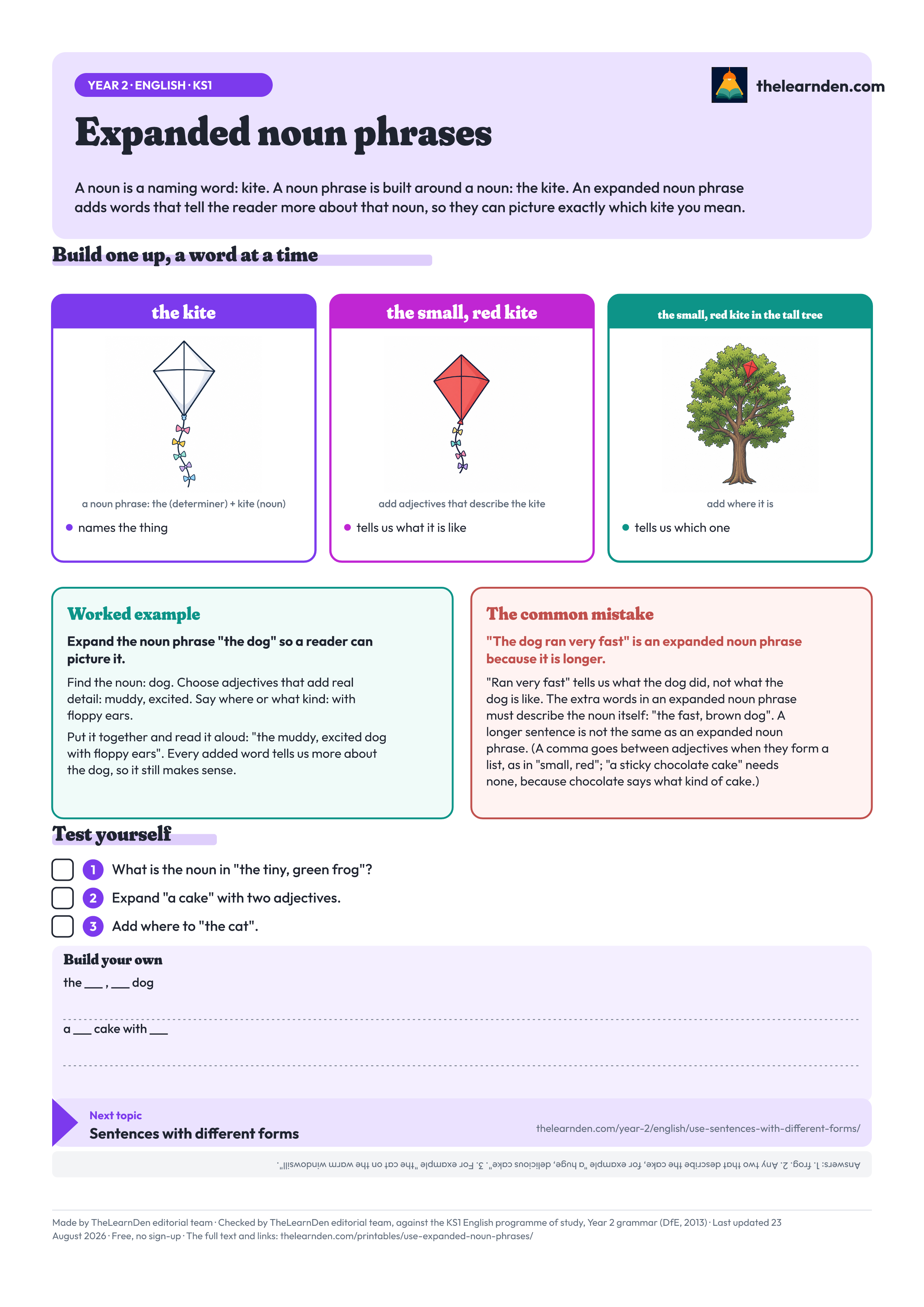
The sheet, written out
Key idea
A noun is a naming word: kite. A noun phrase is built around a noun: the kite. An expanded noun phrase adds words that tell the reader more about that noun, so they can picture exactly which kite you mean.
Build one up, a word at a time
the kite
- names the thing
the small, red kite
- tells us what it is like
the small, red kite in the tall tree
- tells us which one
Worked example
Expand the noun phrase "the dog" so a reader can picture it.
Find the noun: dog. Choose adjectives that add real detail: muddy, excited. Say where or what kind: with floppy ears.
Put it together and read it aloud: "the muddy, excited dog with floppy ears". Every added word tells us more about the dog, so it still makes sense.
The common mistake
"The dog ran very fast" is an expanded noun phrase because it is longer.
"Ran very fast" tells us what the dog did, not what the dog is like. The extra words in an expanded noun phrase must describe the noun itself: "the fast, brown dog". A longer sentence is not the same as an expanded noun phrase. (A comma goes between adjectives when they form a list, as in "small, red"; "a sticky chocolate cake" needs none, because chocolate says what kind of cake.)
Test yourself
- What is the noun in "the tiny, green frog"?
- Expand "a cake" with two adjectives.
- Add where to "the cat".
Build your own
- the ___ , ___ dog
- a ___ cake with ___
- the cat ___ (where?)
Next topic
Questions parents ask
What is an expanded noun phrase?
A noun phrase is a group of words built around a noun, such as "the kite". An expanded noun phrase adds words that describe or specify that noun, such as adjectives or a phrase saying where it is: "the small, red kite in the tall tree". The Year 2 programme of study gives the examples "the blue butterfly", "plain flour" and "the man in the moon".
Where does the comma go?
Between adjectives when they form a list: "the small, red kite". Not when the first word says what kind of thing it is: "a sticky chocolate cake". No comma is needed between the last adjective and the noun.
When is this taught?
Expanded noun phrases for description and specification are in the Year 2 English programme of study in England and are tested in the Key Stage 1 grammar, punctuation and spelling paper.
Is the sheet free?
Yes. One A4 page, PDF or PNG, no sign-up. Print at 100% (actual size).
More like this
- Expanded noun phrases — Year 2
The topic page, with checked videos, lessons and practice.
- All free printables
One-page topic sheets, roadmaps, bookmarks and stickers.