
Year 9 · Maths · KS3 · free one-page sheet
Finding the nth term of a sequence
A free one-page printable on finding the nth term of a linear sequence for Year 9 (KS3) maths: the four-step method, a worked example, the n + 3 mistake, and three quick recall questions. It belongs to our Year 9 Maths page on this topic, where every linked resource has been checked.
Download
A short learning loop
Understand it, try it, remember it
Work through these five steps in order. Nothing is saved, and the tick boxes stay on this page only.
- 1
Understand
The nth term is a rule that gives any term of a sequence straight from its position, n. For a sequence that goes up or down by the same amount each time, the rule is always (that amount) × n, plus or minus a fixed number.
- 2
Try
Find the nth term of 7, 12, 17, 22, …
The difference is 5, so the rule starts 5n. When n = 1, 5n = 5, but the first term is 7, so the rule is 5n + 2.
Test it: n = 3 gives 15 + 2 = 17, which is the third term. Correct.
- 3
Remember
- 4
Apply
Use one checked resource to practise the same idea in a different way.
- 5
Next step
The sheet, written out
Key idea
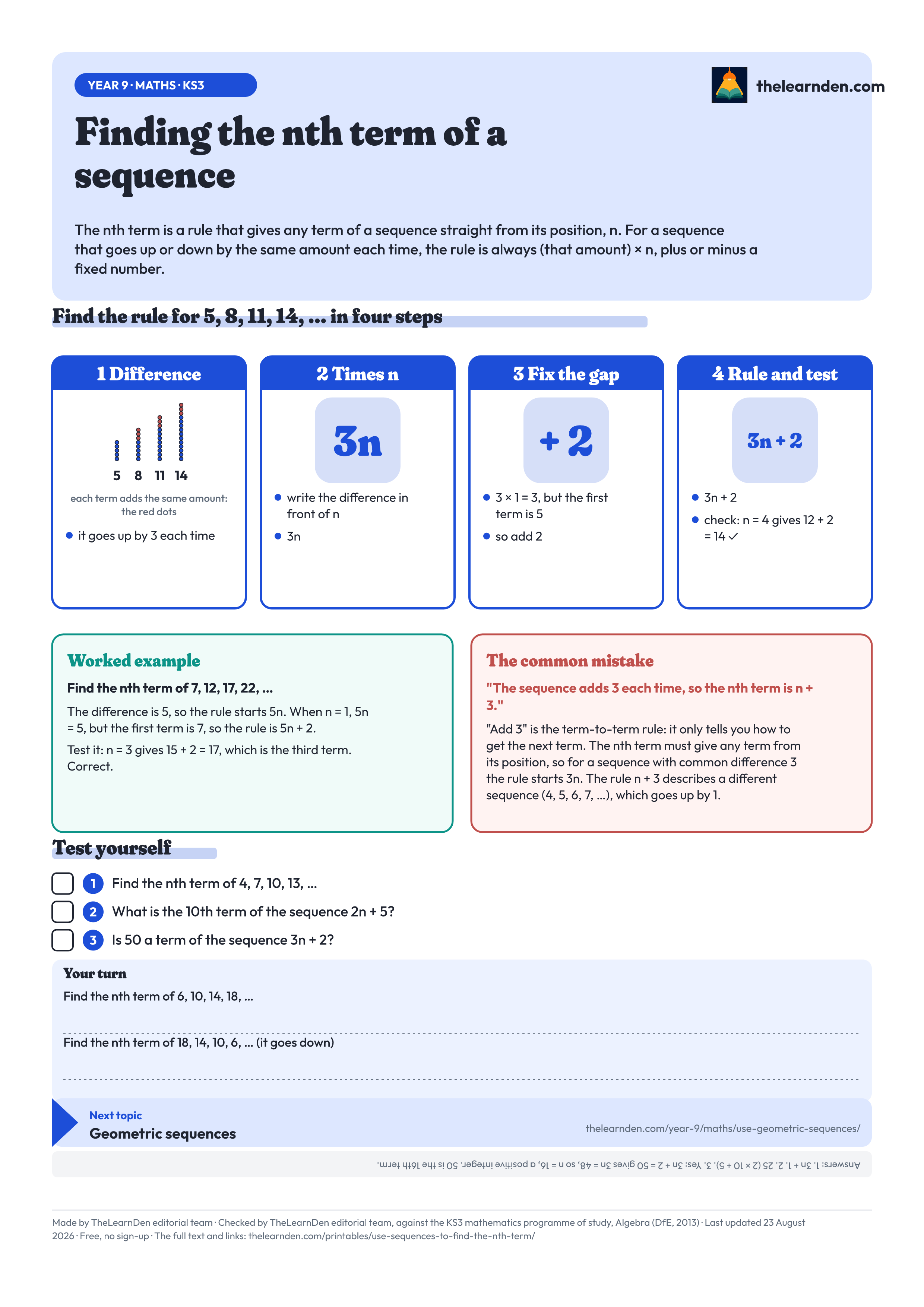
The nth term is a rule that gives any term of a sequence straight from its position, n. For a sequence that goes up or down by the same amount each time, the rule is always (that amount) × n, plus or minus a fixed number.
Find the rule for 5, 8, 11, 14, … in four steps
1 Difference
- it goes up by 3 each time
2 Times n
- write the difference in front of n
- 3n
3 Fix the gap
- 3 × 1 = 3, but the first term is 5
- so add 2
4 Rule and test
- 3n + 2
- check: n = 4 gives 12 + 2 = 14 ✓
Worked example
Find the nth term of 7, 12, 17, 22, …
The difference is 5, so the rule starts 5n. When n = 1, 5n = 5, but the first term is 7, so the rule is 5n + 2.
Test it: n = 3 gives 15 + 2 = 17, which is the third term. Correct.
The common mistake
"The sequence adds 3 each time, so the nth term is n + 3."
"Add 3" is the term-to-term rule: it only tells you how to get the next term. The nth term must give any term from its position, so for a sequence with common difference 3 the rule starts 3n. The rule n + 3 describes a different sequence (4, 5, 6, 7, …), which goes up by 1.
Test yourself
- Find the nth term of 4, 7, 10, 13, …
- What is the 10th term of the sequence 2n + 5?
- Is 50 a term of the sequence 3n + 2?
Your turn
- Find the nth term of 6, 10, 14, 18, …
- Find the nth term of 18, 14, 10, 6, … (it goes down)
- Is 40 a term of 3n + 1? Show your working.
Next topic
Questions parents ask
How do you find the nth term of a sequence?
Find the common difference, write it in front of n, then compare with the first term and add or subtract whatever is needed. For 5, 8, 11, 14 the difference is 3, so the rule starts 3n; 3 × 1 = 3 but the first term is 5, so the nth term is 3n + 2.
What is the difference between the term-to-term rule and the nth term?
The term-to-term rule, such as "add 3", only takes you from one term to the next. The nth term, such as 3n + 2, gives any term directly from its position, so you can find the 100th term without writing out the first 99.
When is this taught?
Generating terms of a sequence from an nth-term rule and finding the nth term are in the Key Stage 3 mathematics programme of study, usually met in Year 7 and revisited in Year 9 and at GCSE.
Is the sheet free?
Yes. One A4 page, PDF or PNG, no sign-up. Print at 100% (actual size).
More like this
- Finding the nth term of a sequence — Year 9
The topic page, with checked videos, lessons and practice.
- Year 7 version
The same topic at a different level.
- All free printables
One-page topic sheets, roadmaps, bookmarks and stickers.