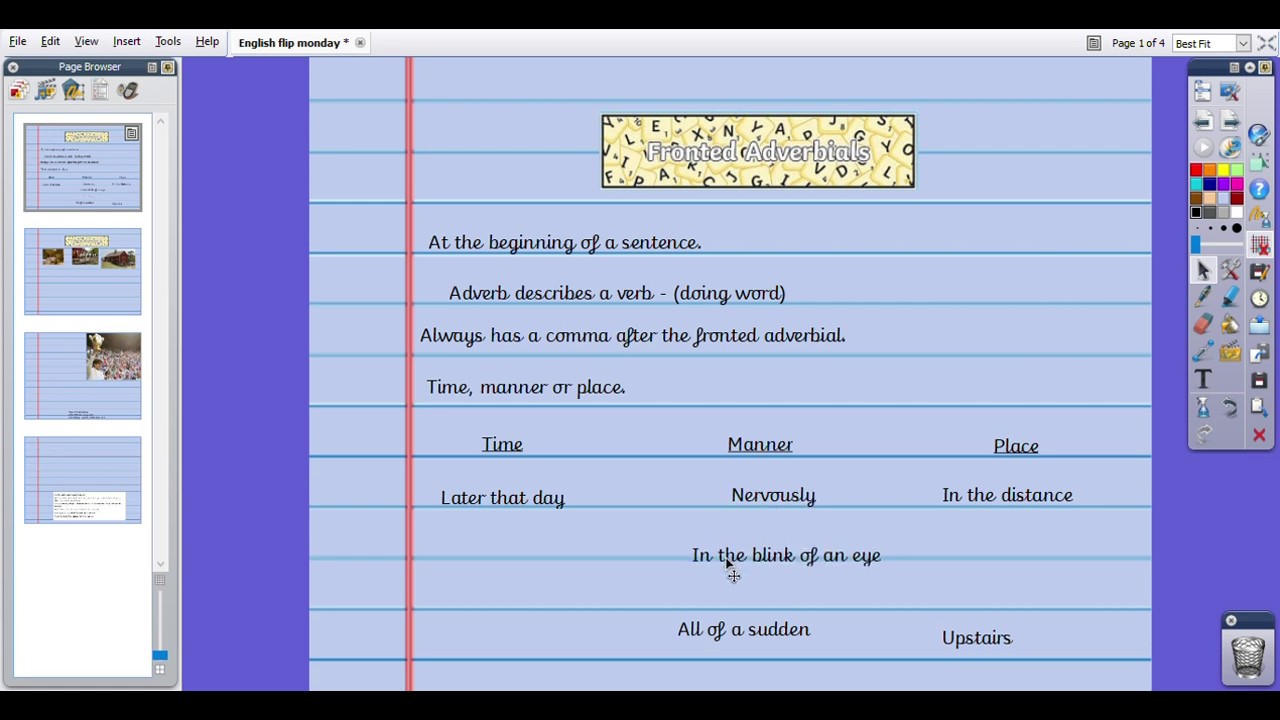
A fronted adverbial comes before the main part of a sentence and can tell us when, where or how something happens. Put a comma after it. Learn with Year 4 examples, a video, our game and a worksheet you can complete online or print.
Allow about 45–60 minutes for Teach, one video and the worksheet. Take a break or finish another day if you need to.
Progress controls need JavaScript. Saving has not been checked.
A fronted adverbial gives extra information before the main part of a sentence. It can tell us when, where or how something happens.
Meet Mina. Which detail could tell a reader where she is?
After breakfast, Mina carried the tray.
Here, “After breakfast” gives the time first. The comma comes after the whole opening.
What you’ll learn
Choose a useful time, place or manner opening.
Keep the whole opening together and add its comma.
Tell an adverbial apart from the subject.
Use and explain an opening in your own writing.
1 · START WITH A COMPLETE SENTENCE
Who is doing what?
Minacarried the tray.
“Mina” tells us who. “Carried” tells us what she did. This main clause can stand as a sentence. The subject, “Mina”, tells us who carried it.
2 · MOVE THE WHOLE PHRASE
Give the time first
Start with “Mina carried the tray after breakfast.” The words “after breakfast” tell us when.
Mina carried the trayafter breakfast.
Compare the two versions
Mina carried the tray after breakfast.
After breakfast, Mina carried the tray.
The event and its time stay the same. The second sentence gives the time first. Put a comma after the whole phrase.
3 · CHOOSE WHAT MATTERS
When, where or how?
Where (place)
Inside the greenhouse, Mina set down the tray.
This opening tells the reader where.
How (manner)
Carefully, Mina set down the tray.
This opening tells the reader how.
See why this choice works
“Inside the greenhouse” gives the location. “Carefully” describes how Mina acts. Either can be useful, depending on what your reader needs.
4 · FIND THE BOUNDARY
Keep the opener together
Beside the greenhouse door Mina left her boots.
Need a hint?
Which words together tell you where Mina left her boots? Keep those words together.
See the answer
Beside the greenhouse door, Mina left her boots.
The whole opening tells us where. Put the comma after “door”, keeping those words together.
5 · CHECK WHAT THE WORDS DO
Not every opening is an adverbial
Subject
The careful gardener watered the seedlings.
“The careful gardener” tells us who watered them. Do not put a comma between this subject and “watered”.
Adverbial
Carefully, the gardener watered the seedlings.
“Carefully” tells us how. It is a fronted adverbial.
See the answer
“The small plants” is the subject: it tells us what grew. Don’t put a comma between “plants” and “grew”. Compare: Inside the greenhouse, the small plants grew quickly. That extra opening tells us where.
6 · TRY SOME NEW OPENINGS
Sort by meaning
Decide whether each opening tells us when, where or how: Before lunch; Under the bench; Quietly.
See the answers
Before lunch: time—when.
Under the bench: place—where.
Quietly: manner—how.
An adverbial can be one word or several words. Its job in the sentence matters.
Now complete a new sentence beginning “Under the bench, …”. Make the rest a complete sentence.
See one example
Under the bench, a cat slept.
“Under the bench” gives the place; “a cat slept” is the main clause. Other sentences can work too.
7 · MAKE A WRITING CHOICE
Improve a short paragraph
The wind shook the greenhouse door. Mina checked the seedlings. She closed the window.
Choose one sentence and add a useful time, place or manner detail at the front. Write on paper or say your version aloud. Keep the other two sentences unchanged. Explain what your reader notices first.
Check your writing
Does the opening add useful information?
Is the main part still a complete sentence?
Is the comma after the whole opening?
Does your sentence fit the paragraph?
Can you explain why you chose that detail?
See one writing example
Before lunch, Mina checked the seedlings.
This adds a time. “Carefully, Mina checked the seedlings” would instead add how she did it. There is no single correct version.
You do not need a fronted adverbial in every sentence. Choose one when its position helps the reader.
8 · TRY A DIFFERENT SCENE
Can you use it somewhere new?
At a library, Sam finds a book and takes it to a table.
Write or say a sentence about Sam. Put a useful time, place or manner detail first. Explain what that opening tells your reader.
Check your sentence
Does your opening tell us when, where or how? Does the main part still make sense as a complete sentence? Is your comma after the whole opening?
One example: Beside the window, Sam opened the book. The opening gives a place. Your sentence can be different.
If you put a comma after the first word, go back to “Keep the opener together”. If you’re unsure whether the opening is a subject, try “Not every opening is an adverbial” again.
Ready for a longer time opening?
When the rain stopped, Mina opened the door.
“When the rain stopped” gives the time. It contains a subject, “the rain”, and a verb, “stopped”, so it is a subordinate clause. Here, the whole clause acts as a fronted adverbial. Our main practice uses single words and phrases.
Another explanation of sentence openings; not every opening shown is a fronted adverbial. Free. Reviewed, not fully verified. Last checked 18 July 2026.
Recognise selected fronted adverbials of time, place and manner, identify what each tells the reader, and choose correct comma placement in supplied sentences. Saving is off unless you choose it.
Choose time, place and manner fronted adverbials and their following comma. Frequency, degree, sentence transformation and independent writing are not assessed.
Recognise selected fronted adverbials of time, place and manner, identify what each tells the reader, and choose correct comma placement in supplied sentences. Saving is off unless you choose it.
Frequency, degree, sentence transformation and independent writing are not assessed.
Write
Year 4 fronted adverbials worksheet
Practise openings and commas with Mina’s story, improve a paragraph, then try a new scene.
The blank worksheet has three pages. You can work online or print a blank copy.
This supports England’s Years 3–4 objectives for fronted adverbials and following commas. The core tasks use words and phrases; the clause example is an optional extension.