
Year 7 · Science
Solids, Liquids and Gases: The Particle Model
Apply the Year 7 particle model
Use particle arrangement and movement to explain an observed property, not only to name the state.
How does the particle model explain solids, liquids and gases?
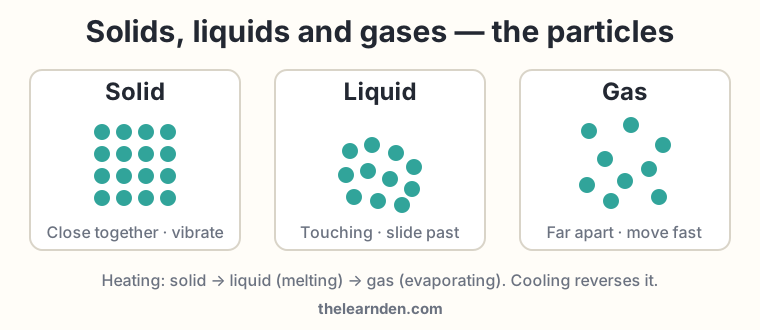
In a solid, particles are close together and vibrate about fixed positions. Liquid particles remain close but move past one another. Gas particles are much farther apart and move rapidly, so gases fill containers and compress. Density depends on the substance. For the same substance, the gas state is normally much less dense because its particles are much farther apart.
| Property | Solid | Liquid | Gas |
|---|---|---|---|
| Shape | Fixed | Takes the container's shape | Fills the container |
| Volume | Fixed | Fixed | Not fixed |
| Particle spacing | Close together | Close together | Much farther apart |
| Movement | Vibrate about fixed positions | Move past one another | Move rapidly in all directions |
Keep practising: Continue to Year 9 density, pressure and model limits · Use the Year 7 Science checklist
Understand the key idea
In a solid, particles are packed closely in fixed positions and can only vibrate, so a solid keeps its shape and volume. In a liquid, particles stay close but slide past one another, so a liquid keeps its volume but takes the shape of its container. In a gas, particles are far apart and move quickly in all directions, so a gas fills whatever space it is given and is easily compressed.
Five introductory states-of-matter questions
- Why does a solid keep its shape? Its particles are close together and vibrate about fixed positions rather than moving past one another.
- Why can a liquid flow while keeping the same volume? Its particles stay close together but can move past one another.
- Why does a gas fill its container? Its particles move rapidly in all directions with large spaces between them.
- Why is a gas easier to compress than a liquid? There is much more empty space between gas particles.
- What changes when ice melts? Particle movement and arrangement change, but the water particles keep the same identity.
Common mix-up
Heating does not make the particles themselves grow. When temperature rises, particles move faster on average; a gas can expand if its container allows it. During melting or boiling at constant pressure, a pure substance can absorb energy without its temperature rising.
Try this first
- Sort shape, volume and compressibility for each of the three states.
- Draw a particle diagram for a solid, a liquid and a gas.
- Explain why a gas can be squashed but a liquid almost cannot.
Ask: Why can you compress the air in a sealed syringe but not the water?
Year 7 learners practise describing particle arrangement and movement in solids, liquids and gases.
The activities include Compare Particle Arrangements in Liquids and Gases, Investigate the Movement of Particles in Solids, Liquids and Gases, Study the Differences Between the Three States of Matter, and related practice. The checked support below includes teaching, interactive, lesson, video. Open a resource in its provider's website and choose the format that best helps the learner explain the idea independently.
Activities covered
Finish one activity, then tap Done to earn one Den Drop ticket. You can earn up to 3 tickets each day.
- Compare Particle Arrangements in Liquids and Gases — support from BBC Bitesize
- Investigate the Movement of Particles in Solids, Liquids and Gases — support from BBC Bitesize
- Study the Differences Between the Three States of Matter — support from Oak National Academy
- Understand the Arrangement of Particles in Solids, Liquids and Gases — support from BBC Bitesize
- Understand the Differences Between Solids and Liquids — support from BBC Bitesize
Share this topic
Share this page with another parent, carer or learner. No personal details are added.
Choose a learning resource
Start with an explanation, then practise, then print. Labels show access and review status before you click.
What the icons and labels mean
Formats
Watch — a video explanation
Learn — a lesson or teaching page to read and work through
Practise — questions or activities to try
Print — a worksheet you can print
Cost and account
Free no payment or account needed for this resource
Free account needed no payment needed, but the provider asks you to create an account
Subscription part of a paid plan on that site
Check access access has not yet been confirmed, so it appears only under Everything
Review status
Verified match checked against this topic, with a visible check date
Reviewed, not fully verified reviewed, with some checks still outstanding
Awaiting review still waiting for review
Tell us how it went
This helped · Link or access problem · Not the right match
We show a free label only after checking the resource's own page. Access can vary by resource. Unconfirmed access appears only under Everything.
Watch it explained
watch a video explanation
What is the arrangement of particles in a solid, liquid and gas?
Best for: a clear explanation before you practise
Melting Particle Model
Best for: a clear explanation before you practise
Solids, liquids and gases - Solids, liquids and gases
Best for: a clear explanation before you practise
Nothing in this step matches your filters.
Learn it properly
lessons and teaching pages
Oak lesson slides: Solid And Liquid States
Best for: worked examples and step-by-step teaching
Oak lesson slides: Particle Model Of Substances In The Gas State
Best for: worked examples and step-by-step teaching
Solid, liquid, gas states and changes of state
Best for: worked examples and step-by-step teaching
Solids, liquids and gases - KS3 Physics
Best for: worked examples and step-by-step teaching
Nothing in this step matches your filters.
Practise it
questions and activities to try
Melting Particle Model worksheet and quiz downloads
Best for: active questions with immediate feedback
Nothing in this step matches your filters.
Print and finish
worksheets away from the screen
Oak worksheet: Particle Model Of Substances In The Gas State
Best for: pencil-and-paper practice away from the screen
Oak worksheet: Solid And Liquid States
Best for: pencil-and-paper practice away from the screen
The Particle Model and States of Matter Worksheet
Best for: pencil-and-paper practice away from the screen
Nothing in this step matches your filters.