TheLearnDen

Year 9 · Science

Properties of Solids, Liquids and Gases

Solids keep their shape and volume. Liquids keep their volume but take the shape of their container, while gases spread to fill the available space. Use this Year 9 lesson to explain why with particle models, a video, a recap game and a worksheet you can complete online or print.

Allow about 30 minutes for the lesson and one practice choice. Pause or finish another day if you need.

Progress controls need JavaScript. Saving has not been checked.

Find more resources

1 Teach: explain what particles do

Solids keep their shape and volume. Liquids keep their volume but take the shape of their container. Gases spread to fill the space available. The particle model helps explain these differences.

Sam compares a solid wooden block, liquid water in a beaker and air inside a balloon.
The block is solid. The water is liquid. The air inside the balloon is a gas.
What you’ll learn
  • Compare particle arrangement and movement in solids, liquids and gases.
  • Explain shape, volume, flow and compression using the particle model.
  • Correct the idea that solid particles do not move.
  • Keep particle size and count unchanged in each model.

1 · CONNECT THE MODEL TO THE PROPERTY

Same idea, three different states

A solid can keep its shape because its particles stay close together in fixed positions. They still vibrate. In a liquid, particles stay close together but can move past one another, so it flows. Gas particles are far apart and move in all directions, so a gas fills the available space.

Compare particle arrangement and movementTwelve same-sized model particles. Choose a state to compare.

Solid: close particles vibrate about fixed positions. The solid keeps its own shape and volume.

Liquid: close particles move past one another. The liquid keeps its volume and takes the shape of its container.

Gas: widely spaced particles move in all directions. The gas fills its container and can be compressed.

The twelve dots stand for particles. Their size and number stay the same. Movement stops after a short comparison. Solids can have different particle arrangements. The pictures are not to scale.
Sam pours water into a wider bowl without spilling any. What stays the same?

2 · EXPLAIN WHY A GAS CAN BE COMPRESSED

Same gas, less room

Hold the amount of gas fixed and keep temperature unchanged. In a smaller volume, the same particles are closer together, so the gaps decrease. Their size and count do not change.

Density is mass divided by volume. It increases because the same mass occupies less volume. Pressure rises because particles reach the container walls more often. The fixed temperature keeps average particle speed the same for this comparison.

Need a hint?

Keep temperature the same in both pictures. Look at the amount of gas, the volume and the gaps.

Compress the same gas

Compress the same gasSame gas, starting volume. Watch the gaps between the particles.

Same gas, starting volume. Watch the gaps between the particles.

Eight particles throughout. Particle size stays the same. Model not to scale.

3 · CHECK YOUR EXPLANATION

Sam says, “Particles in a solid do not move.”

Correct Sam’s claim. Explain how a solid can keep its shape even though its particles move.

Show the answer

Solid particles vibrate about fixed positions. They do not move past one another as liquid particles do, so the solid keeps its shape. Fixed positions do not mean the particles are motionless.

Go further: density and pressure

You can finish the main lesson without these extra investigations. Use them when you are ready to connect the particle model to density and warming.

EXTEND · DENSITY

Use mass divided by volume

Sample A has mass 24 g and volume 8 cm³. Its density is 24 g ÷ 8 cm³ = 3 g/cm³. Sample B has 30 g in 30 cm³, so its density is 1 g/cm³. A is denser.

Density compares mass with volume. A denser material is not automatically a solid; different substances can have different densities.

A block has mass 18 g and volume 6 cm³. What is its density?

EXTEND · WARM A GAS

Fixed volume, faster particles

Now keep the same amount of gas in a sealed rigid container, so its volume stays fixed. Warming increases average kinetic energy; particles move faster on average. Their collisions with the walls become more frequent and more forceful, so force per unit area and pressure rise.

The density stays the same because mass and volume stay the same. Particles do not grow when warmed.

Need a hint?

Keep the rigid container and amount of gas fixed. What changes about particle movement and wall collisions?

Warm a gas in a rigid container

Warm a gas in a rigid containerSame gas, fixed volume. Watch the speed of the particles.

Same gas, fixed volume. Watch the speed of the particles.

Eight particles throughout. Particle size stays the same. Model not to scale.
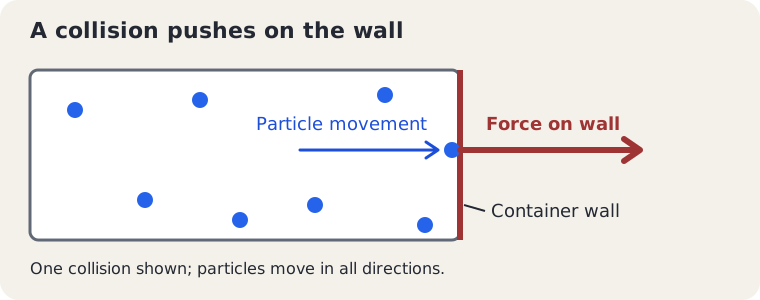
Look closer at a wall collision
A particle moves right towards a container wall and pushes the wall to the right. The wall pushes back on the particle in the opposite direction.
The particle moves toward the wall and pushes the wall away from the gas. The wall pushes back on the particle in the opposite direction. Pressure is force per area from many collisions.
The gas warms in the same sealed rigid container. What happens to its density?

2 Watch an explanation

Watch how particle arrangement and movement explain the properties of the three states. Pause to connect each model to its shape and volume.

States of matter: solids, liquids and gases

Watch on YouTube

FuseSchool · YouTube · short recap

Shows the arrangement and movement of particles in solids, liquids and gases. Use it to explain why liquids flow and why gases fill a container.

Back from a resource?

Why can a liquid flow while a solid keeps its shape? Use particle arrangement and movement in your answer.

Show a reminder

Liquid particles can move past one another. Solid particles vibrate about fixed positions. Both have particles close together.

Practice what you’ve learned

Choose a game or a worksheet. You can try both.

Play

Particle model game

Revisit particles, states and collisions in our Year 7 recap. Use it to check the particle-model ideas from this lesson.

Play the particle recap game

TheLearnDen · KS3 recap

Write

Sam’s particle model worksheet

Start with tasks 1 and 2: compare the three states, then explain gas compression. Tasks 3 to 6 extend the model to density and warming. You can leave those for another time.


Do the worksheet onlineDownload a blank worksheet (PDF)

Free lesson and recap game · Year 9 · Worksheet online or on A4 · Blank PDF: three pages · Separate adult answers

Density and pressure worksheet answers (PDF): the separate adult key. Keep it aside while the learner works.

Before you finish

Explain why a solid keeps its shape, a liquid flows and a gas can be compressed. Use what the particles do, rather than just naming the states.

My activity record 6 skills to practise

Skills for this topic

Open a matched resource below, then mark the skill after you have practised it. These are skills within this Year 9 topic.

One resource can help with several skills. Our game and worksheets are in Practice above.

If this browser can save your activity marks, they stay on this device. Use Undo Done to undo a mark. Tickets already earned stay unchanged.

  • Explore the Arrangement of Particles in Solids, Liquids and Gases
    Watch video

    Watch: YouTube — FuseSchool - Global Education · Check access

    Other resources for this skill (2)
  • Investigate the Arrangement of Particles in Solids, Liquids and Gases
    Watch video

    Watch: YouTube — FuseSchool - Global Education · Check access

    Other resources for this skill (2)
  • Investigate the Properties of Solids, Liquids and Gases
    Watch video

    Watch: YouTube — FuseSchool - Global Education · Check access

    Other resources for this skill (2)
  • Learn About the Properties of Liquids and Gases
    Watch video

    Watch: YouTube — Point Source Science · Check access

    Other resources for this skill (2)
  • Understand the Arrangement of Particles in the Three States of Matter
    Watch video

    Watch: YouTube — FuseSchool - Global Education · Check access

    Other resources for this skill (2)
  • Understand the Properties of Solids, Liquids and Gases
    Watch video

    Watch: YouTube — Point Source Science · Check access

    Other resources for this skill (2)

Find more resources

We match these resources to the topic. Check each provider’s access and review labels before you open a resource. How we choose resources.

More help with the extensions

Density: mass and volume

The BBC Bitesize density guide gives the equation, units and worked examples.

Read the BBC Bitesize density guide

Changes of pressure

Oak National Academy’s KS4 Year 10 combined-science foundation AQA lesson explores pressure when a gas warms at fixed volume.

Open the Oak Year 10 extension

More ways to learn

Explore the resources matched to this topic. Choose the types you want to see.

Access

All free includes resources that ask for a free account.

Resource type
4 of 4 extra resources
What the icons and labels mean

Formats

Watch. a video explanation

Teach. a lesson or teaching page to read and work through

Practice. questions, activities or worksheets to try

Cost and account

Free no payment or account needed for this resource

no payment needed, but the provider asks you to create an account

part of a paid plan on that site

Check access access has not yet been confirmed, so it appears only under Any access

Review status

Verified match checked against this topic, with a visible check date

Reviewed, not fully verified reviewed, with some checks still outstanding

Awaiting review still waiting for review

Tell us how it went

This helped · Link or access problem · Not the right match

We show a free label only after checking the resource's own page. Access can vary by resource. Unconfirmed access appears only under Any access.

TeachOak National Academy

Solids, liquids and gases: lesson sequence

Best for: Explore a wider lesson sequence about how materials change state.

Check access

Check access on the provider’s site.

Open at Oak National Academy

WatchYouTube — Point Source Science

Properties of solids, liquids and gases

Best for: Compare particle arrangement, movement and properties in the three states.

Check access

Check access on the provider’s site.

Open at YouTube — Point Source Science

PracticeBBC Bitesize

BBC Bitesize topic page

Best for: Explore BBC Bitesize information about solids, liquids and gases.

Check access

Check access on the provider’s site.

Open the BBC Bitesize topic page

Resource feedback needs JavaScript and the native feedback controls. No feedback has been submitted.

Where next?

Browse all Year 9 Science lessons

Share this lessonWhatsApp