
Year 9 · Science · KS3 · free one-page sheet
Properties of solids, liquids and gases
A free one-page printable on the properties of solids, liquids and gases for Year 9 (KS3) science: the particle model in one table, a worked exam-style answer, the common mistake, and three recall questions. It belongs to our Year 9 Science page on this topic, where every linked resource has been checked.
Download
A short learning loop
Understand it, try it, remember it
Work through these five steps in order. Nothing is saved, and the tick boxes stay on this page only.
- 1
Understand
The particle model says that all matter is made of tiny particles. How close together they are, how they are arranged and how they move explains what each state of matter can and cannot do.
- 2
Try
Explain why a gas can be squashed into a smaller space but a liquid cannot.
In a gas the particles are far apart, with empty space between them. Pushing on the gas moves the particles closer together, so it takes up less room.
In a liquid the particles are already touching. There is almost no empty space to push them into, so the volume barely changes.
- 3
Remember
- 4
Apply
Use one checked resource to practise the same idea in a different way.
- 5
Next step
The sheet, written out
Key idea
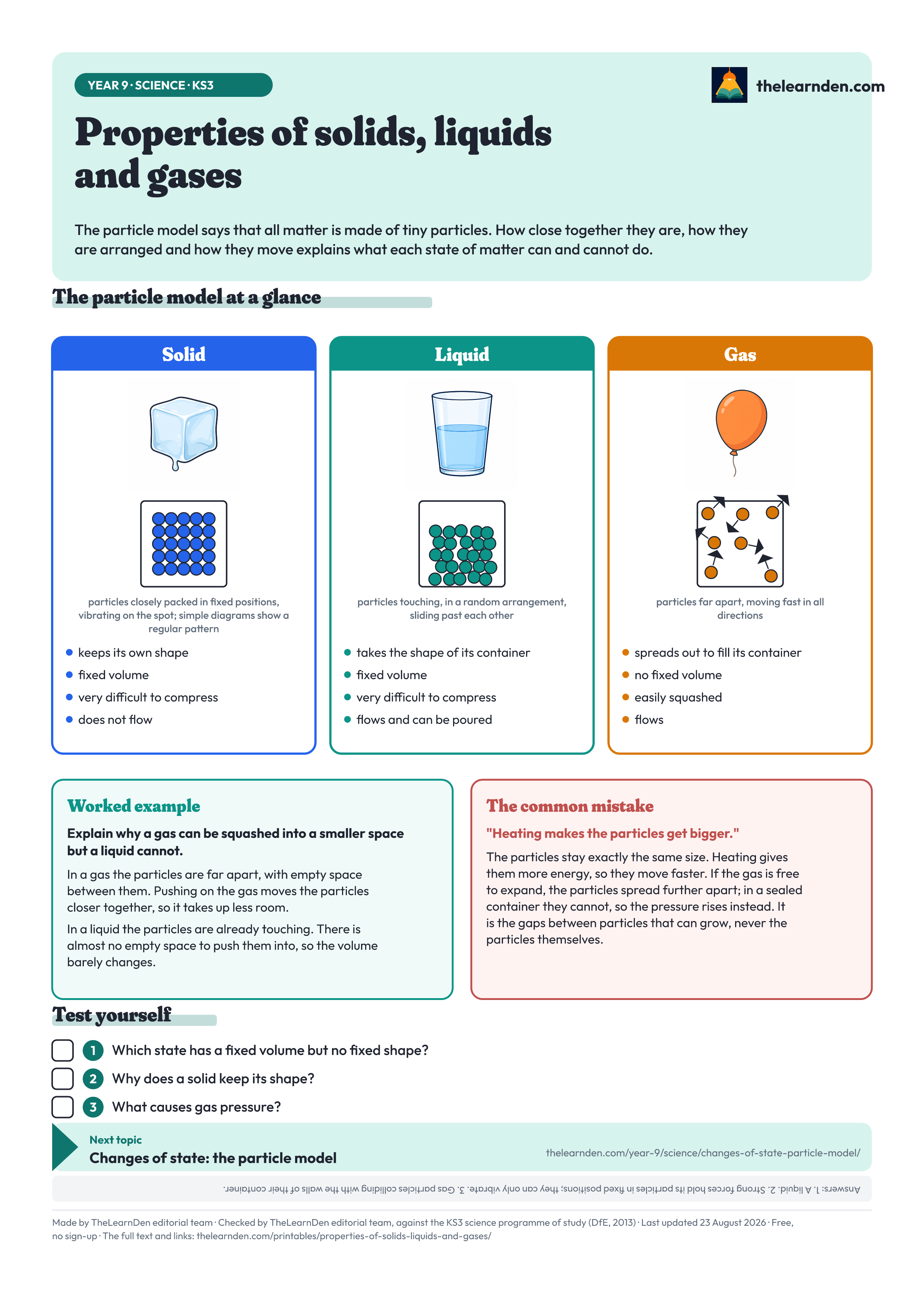
The particle model says that all matter is made of tiny particles. How close together they are, how they are arranged and how they move explains what each state of matter can and cannot do.
The particle model at a glance
Solid
- keeps its own shape
- fixed volume
- very difficult to compress
- does not flow
Liquid
- takes the shape of its container
- fixed volume
- very difficult to compress
- flows and can be poured
Gas
- spreads out to fill its container
- no fixed volume
- easily squashed
- flows
Worked example
Explain why a gas can be squashed into a smaller space but a liquid cannot.
In a gas the particles are far apart, with empty space between them. Pushing on the gas moves the particles closer together, so it takes up less room.
In a liquid the particles are already touching. There is almost no empty space to push them into, so the volume barely changes.
The common mistake
"Heating makes the particles get bigger."
The particles stay exactly the same size. Heating gives them more energy, so they move faster. If the gas is free to expand, the particles spread further apart; in a sealed container they cannot, so the pressure rises instead. It is the gaps between particles that can grow, never the particles themselves.
Test yourself
- Which state has a fixed volume but no fixed shape?
- Why does a solid keep its shape?
- What causes gas pressure?
Next topic
Questions parents ask
What are the properties of solids, liquids and gases?
Solids keep their shape and volume and are very difficult to compress, because their particles are closely packed in fixed positions and only vibrate. Liquids keep their volume but take the shape of their container and can flow, because their particles are touching but can slide past each other. Gases fill whatever container they are in, flow, and can be compressed easily, because their particles are far apart and move fast in all directions.
Why can a gas be compressed but a liquid cannot?
Gas particles have large empty spaces between them, so pushing on a gas moves the particles closer together. Liquid particles are already touching, so there is almost no space to push them into.
When is this taught in England?
The particle model of solids, liquids and gases is in the Key Stage 3 science programme of study, so schools cover it somewhere in Years 7 to 9. On TheLearnDen it sits under Year 9, with a Year 7 version and a simpler Year 4 version for primary.
Is the sheet free to print and share?
Yes. It is a single A4 page, free, with no sign-up. Print it at 100% (actual size) and it will fit the page.
More like this
- Properties of solids, liquids and gases — Year 9
The topic page, with checked videos, lessons and practice.
- Year 7 version
The same topic at a different level.
- Year 4 version
The same topic at a different level.
- All free printables
One-page topic sheets, roadmaps, bookmarks and stickers.